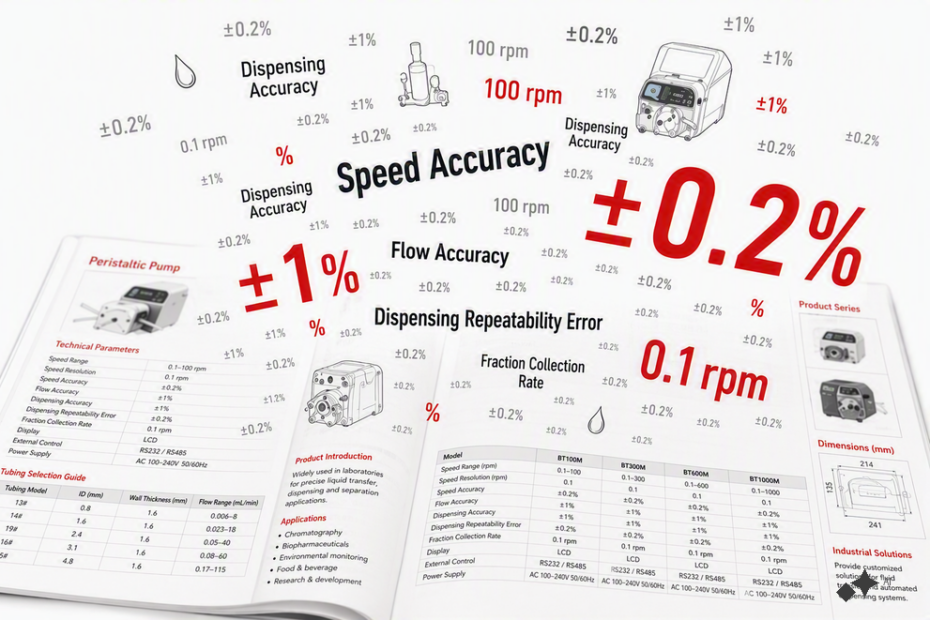
When selecting a peristaltic pump, do you compare values like ±0.2% and ±1% in the specification sheet and assume that smaller is always better? Not so fast. Although many parameters are labeled as “accuracy” or “error rate,” some refer to speed, some to flow rate, and others to dispensing performance. The numbers may look similar, but the meanings can be completely different.
In this article, we’ll clarify the most common accuracy-related parameters used in peristaltic pumps, helping you interpret specification sheets with confidence.
Understanding the Fundamentals: Accuracy Has Two Dimensions
Many people assume that accuracy simply means how close the actual value is to the set value. While that is partly true, it does not tell the whole story.
According to ISO 5725, measurement accuracy should be evaluated from two perspectives:
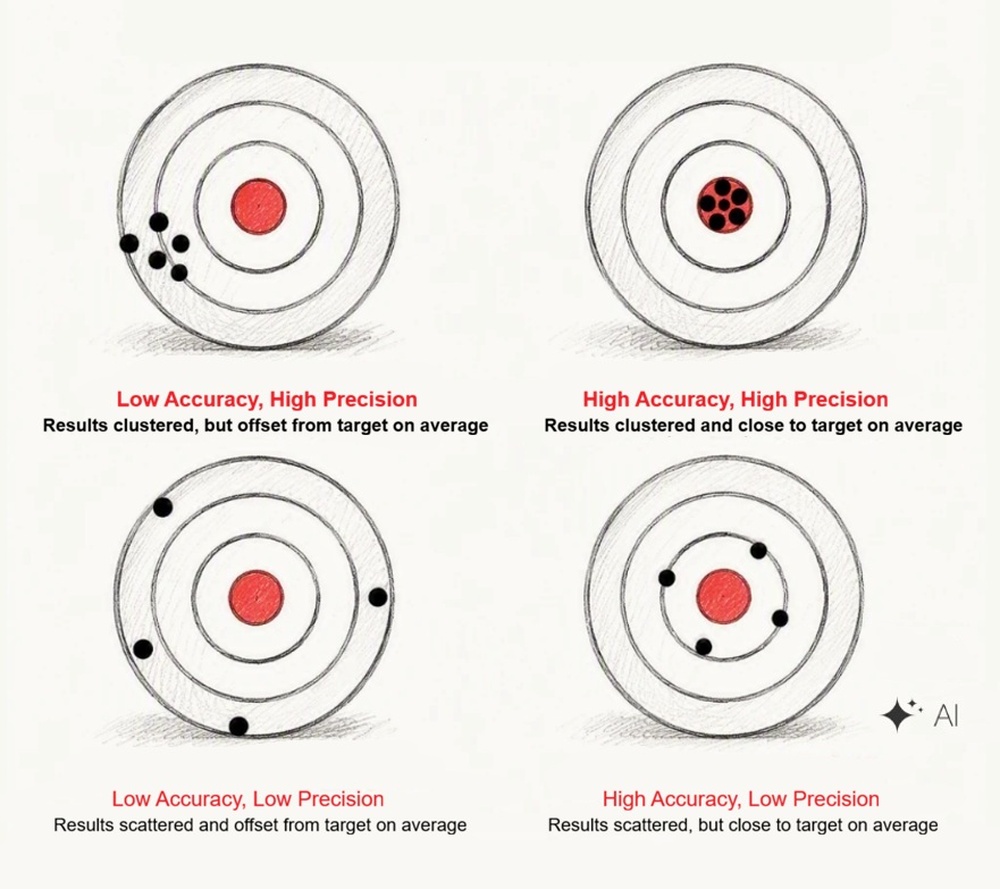
Trueness
Trueness indicates whether the average value of multiple measurements is close to the target value.
Precision
Precision describes whether multiple measurements are consistent with one another, meaning how closely they cluster together.
In simple terms:
• Trueness answers: “Is the average result correct?”
• Precision answers: “Are repeated results consistent?”
For different products and applications, specific performance indicators must be tested and evaluated according to appropriate methods that reflect their working principles and intended use.
All performance parameters in Lead Fluid product documentation are tested according to relevant internal standards. Because different parameters focus on different performance aspects, they do not necessarily describe the same thing.
Trueness VS Accuracy
Industry Usage of “Accuracy”
In peristaltic pump specifications, terms such as dispensing accuracy or error rate are long-established industry conventions used primarily to describe the consistency of repeated dispensing results under specified conditions. From a metrological perspective, however, this evaluation is more closely related to precision. For consistency with common industry terminology, the term accuracy will continue to be used throughout the remainder of this article.
Tip: In product specifications, dispensing performance may be expressed either as a percentage, such as Dispensing Accuracy: ±0.3%, or as a specific volumetric deviation, such as 10 μL ± 0.15 μL. The latter is typically reported as a dispensing error.
What Is Trueness?
Trueness focuses on whether the average dispensing result is close to the target value.
Example: Suppose the target dispensing volume is 100 mL.
•If multiple dispensing results are consistently clustered around 98 mL, it indicates that the outputs are highly consistent from one cycle to another, meaning the dispensing accuracy (as commonly referred to in the industry) is relatively high. However, since the average result still deviates from the target value of 100 mL, there is still room for improvement in trueness.
- If the average of multiple dispensing results is close to 100 mL, the system can be considered to have high trueness. The level of accuracy (or precision, in metrological terms), on the other hand, depends on the degree of variation among the individual dispensing results.
In peristaltic pump applications, flow calibration can be used to reduce deviation between the actual output and the target value, bringing dispensing results closer to the desired volume.
Note: Precision is a metrology concept. While Lead Fluid product parameters are evaluated in a similar direction, specific testing methods and evaluations are performed according to the applicable company standards.
Speed Accuracy VS Flow Accuracy
- Speed Accuracy
Reflects the deviation between the actual rotational speed and the set rotational speed.
Speed accuracy reflects the deviation between the actual rotational speed and the set speed. Taking the Lead Fluid S Series peristaltic pump as an example, the specifications indicate a speed accuracy of ±0.2%. If the pump is set to 100 rpm, the actual speed will remain within the range of 99.8 to 100.2 rpm. This parameter primarily evaluates the performance of the drive control system, in other words, how accurately the pump head rotates at the commanded speed.
- Flow Accuracy
Flow accuracy is a fluid performance indicator of the complete pump system, focusing on the peristaltic pump’s continuous flow output performance under specified operating conditions.
Although the two parameters are related, they are not identical. Under ideal operating conditions, the theoretical flow rate of a peristaltic pump can be approximated as:
Q ≈ N × V
where Q is the flow rate, N is the rotational speed, and V is the volume delivered per revolution.
When the volume delivered per revolution remains relatively stable, more accurate speed control contributes to a more stable flow output.
However, in real-world applications, the volume delivered per revolution is not constant. Factors such as tubing dimensions, tubing material, tubing wear and condition, fluid viscosity, temperature, and system back pressure can all affect tubing recovery and the effective displacement per revolution, thereby influencing the actual flow rate.
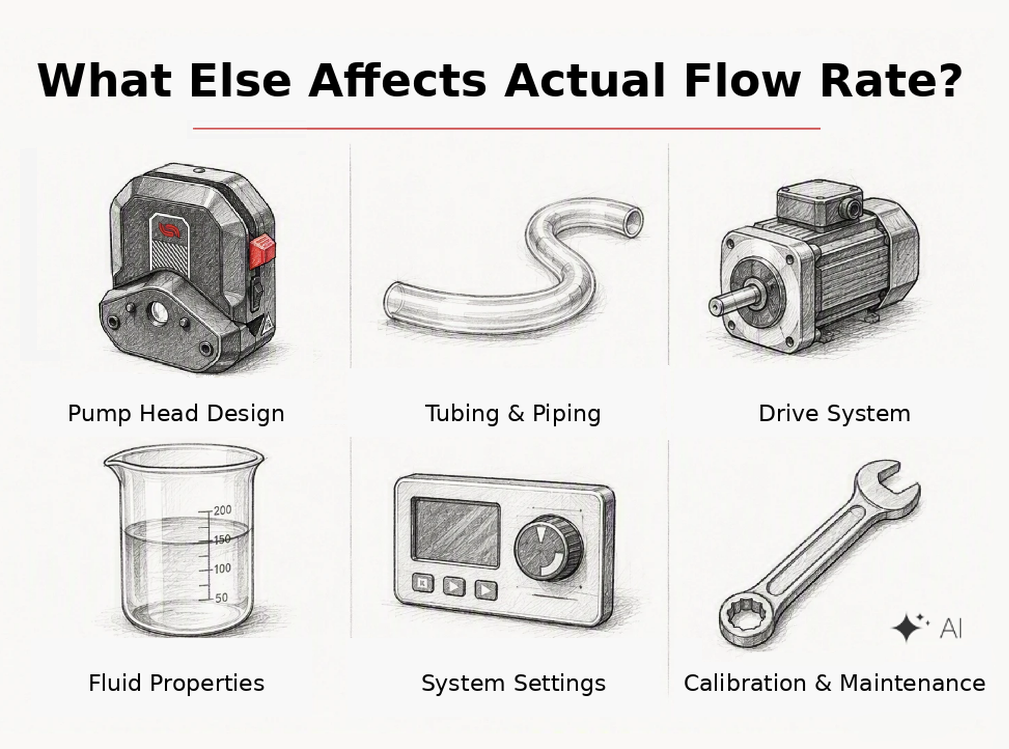
Speed accuracy is an important factor affecting flow performance, but it does not directly represent the overall flow accuracy of the pump system.
Resolution VS Trueness
Besides the various types of accuracy and error metrics, there is another parameter in specification sheets that is often misunderstood: resolution.
- Resolution
Resolution refers to the smallest increment that a device can display or be configured to use, similar to the smallest graduation on a ruler. For example, a speed resolution of 0.1 rpm means that the rotational speed can be set or displayed in increments of 0.1 rpm, such as 100.1 rpm or 100.2 rpm, rather than being limited to whole-number values like 100 rpm or 101 rpm.
- Trueness
Trueness refers to how closely the actual performance matches the set value. The fact that a pump’s speed can be set in increments of 0.1 rpm does not mean that the deviation between the actual speed and the set speed is limited to ±0.1 rpm.
For example, a digital scale that displays weight to two decimal places has high resolution. But if it consistently measures 0.5 kg more than the actual weight, its trueness is low.
Resolution tells you how small the measurement increments can be, while trueness tells you how accurate the actual result is.
Three Questions to Ask Before Comparing Specifications
- What is being measured?
Is the parameter describing rotational speed, continuous flow rate, or volumetric dispensing performance?
- What is it being compared against?
Is the parameter comparing the actual result to the set value, or is it evaluating the consistency among multiple results?
- Under What Conditions Was It Measured?
Were the tests conducted using the same tubing type, fluid properties, and operating parameters? Changes in any of these factors can significantly affect the results.
Meaningful comparisons can only be made after clearly understanding what each parameter measures, how it is evaluated, and under what conditions it is tested. By looking beyond the numbers and understanding the logic behind the evaluation methods, you can gain a more accurate understanding of a product’s actual performance.