Skip to content
Home » Products » Applications

Applications

How to Choose a Laboratory Peristaltic Pump?

  • by

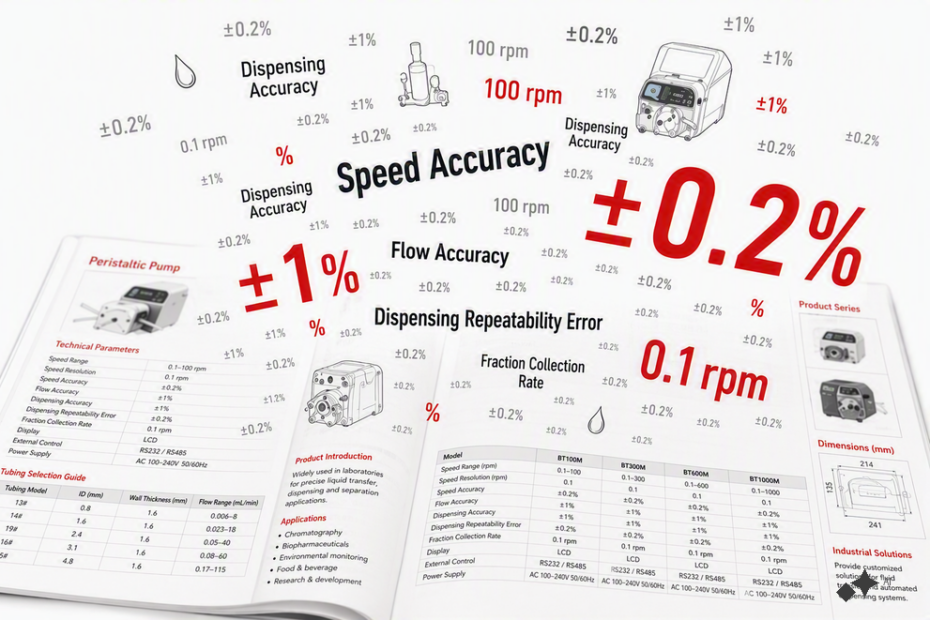
A laboratory peristaltic pump is a widely used fluid transfer device in research laboratories, biopharmaceuticals, chemical analysis, and environmental testing. Thanks to its advantages such as fluid contact only with the tubing, no cross-contamination, and easy maintenance, the laboratory peristaltic pump has become a preferred choice for many laboratory applications. Proper peristaltic pump selection is essential to ensure experimental accuracy and long-term stable operation. When choosing a laboratory peristaltic pump, the first factor to consider is the flow rate range and flow accuracy. Different laboratory applications have different requirements for… Read More »How to Choose a Laboratory Peristaltic Pump?

What Are the Key Parameters for OEM Custom Peristaltic Pumps?

  • by

As equipment integration and system matching become increasingly sophisticated, more and more customers are opting for OEM customized peristaltic pumps to meet specific operating conditions and structural requirements. Compared with standard products, OEM customization places greater emphasis on precise parameter matching and long-term operational stability. Therefore, clearly defining the core parameters at the early stage of a project is particularly critical. Flow Rate and Speed Range The first key consideration is the required flow rate and speed range. Customers should clearly define the actual flow range, speed control accuracy, and… Read More »What Are the Key Parameters for OEM Custom Peristaltic Pumps?

How Does the WSP3000 Pump Help Make POCT More Accurate?

  • by

Have you ever experienced this: ➡️ Your child has a fever—common cold, influenza A or B?In the past, you had to go to the hospital, but now many parents’ first reaction is to use a small testing kit at home. ➡️During a health check, the doctor uses a compact device and prints the report on site—no need to wait until tomorrow.These increasingly common scenarios represent the essence of POCT (Point-of-Care Testing). What is POCT? Traditional testing requires sending samples to centralized laboratories, taking hours or even a day to receive results.POCT (point‑of‑care… Read More »How Does the WSP3000 Pump Help Make POCT More Accurate?

Peristaltic Pump VS Syringe Pump: What’s the Difference?

  • by

In the field of precise fluid control, peristaltic pumps and syringe pumps are two commonly used types of delivery equipment. They are widely applied in medical, scientific research, and industrial settings. However, due to differences in working principles and performance characteristics, selecting the right device requires understanding their distinctions. So, what exactly sets these two types of pumps apart? This article provides a brief overview. First, in terms of operating principles, a peristaltic pump delivers fluid by using rollers to compress and release a flexible tube, pushing the fluid forward… Read More »Peristaltic Pump VS Syringe Pump: What’s the Difference?

International Women’s Day – A Tribute to Extraordinary Women

  • by

The spring breeze is gentle, and everything grows toward the sun.On this beautiful holiday belonging to women,We pay tribute to every courageous, independent, gentle, and resilient woman. Strength lies beneath their smiles,They continue contributing in their roles;They grow amid busyness,And in the process of creating value, they bloom like flowers. At Lead Fluid, there is also such a group of women:With professionalism they shape quality, with craftsmanship they guard the beauty of fluid engineering,Letting “her power” shine in everyday moments. A tribute to all the women’s strength in the world.May… Read More »International Women’s Day – A Tribute to Extraordinary Women

How to Choose a Peristaltic Pump for Laboratory Use?

  • by

With the continuous development of scientific research, laboratories are placing higher demands on the precision, stability, and safety of liquid transfer equipment. Peristaltic pumps have become widely used in biology, chemistry, pharmaceuticals, and other laboratory settings due to their advantages, including contamination‑free transfer, strong controllability, and easy maintenance. So, how should laboratories select the right peristaltic pump? First, it is essential to clarify the experimental requirements. Different applications may require different flow ranges, transmission accuracy, and compatibility with various liquid properties. For example, biological experiments often require contamination‑free liquid handling,… Read More »How to Choose a Peristaltic Pump for Laboratory Use?

Embracing a New Chapter · Uniting New Momentum | Lead Fluid 2026 Annual Gala Successfully Concluded

  • by

As the Year of the Snake comes to an end and the Year of the Horse approaches,the 2026 Lead Fluid Annual Gala, themed “Embracing a New Chapter · Uniting New Momentum — Heart Integration · New Momentum”, was grandly held!All Lead Fluid employees gathered together to celebrate the successful conclusion of 2025 and to stride confidently into 2026! Opening · A Film That Touched Every Heart The event opened with a specially produced video, drawing everyone’s attention once again to Lead Fluid’s journey of growth. From our humble beginnings to… Read More »Embracing a New Chapter · Uniting New Momentum | Lead Fluid 2026 Annual Gala Successfully Concluded

MF103 Application Guide | Reliable Fluid Transfer for Biopharmaceutical, Industrial, and Laboratory Scenarios

  • by

In the previous article, we explored the five core design elements of the MF103, uncovering the source of its technical “strength.” However, technology only reveals its true value when applied to practical scenarios.Across different industries, fluid transfer faces similar ultimate challenges — how to achieve long‑term stability and precision under harsh physical and chemical conditions. This is not only a performance concern, but also one related to risk control, continuous production, and R&D efficiency. Today, we focus on biopharmaceutical, laboratory, and industrial applications to understand why the MF103, with its high… Read More »MF103 Application Guide | Reliable Fluid Transfer for Biopharmaceutical, Industrial, and Laboratory Scenarios

New Product Launch | Lead Fluid’s High-Protection Series — MF103

  • by

Real‑World Conditions Are Tough—and Unforgiving Frequent cleaning and sterilization, hot and humid splashing, confined spaces, airborne dust, and corrosive aerosols…In such environments, equipment must deliver not only precision, but also stability, durability, and compactness. The Lead Fluid MF103 High‑Protection Peristaltic Pump was engineered exactly for these challenges.With a compact near‑point installation, precise flow control up to ≤ 3000 mL/min, and an IP66 protection rating, MF103 brings the concept of “small yet stable” into real‑world operation. Designed for a wide range of applications, including biopharmaceuticals, laboratories, new energy, textile printing & dyeing, marine… Read More »New Product Launch | Lead Fluid’s High-Protection Series — MF103

Peristaltic Pump Tube Selection Guide: Ensure Safe Transfer and Stable Performance

  • by

As a core component of peristaltic pumps, tubing plays a critical role in determining fluid safety and pump longevity. The choice of tubing material directly affects performance and durability. Different applications require different tubing types. This article introduces common peristaltic pump tubing options and their characteristics to help businesses make informed decisions. Silicone Tube: Preferred for Pharmaceutical and Food Industries Silicone tubing offers excellent flexibility and high-temperature resistance, making it ideal for applications with strict hygiene requirements such as pharmaceuticals and food processing.Advantages:• Wide temperature range: -50°C to 200°C• Non-toxic… Read More »Peristaltic Pump Tube Selection Guide: Ensure Safe Transfer and Stable Performance