

If you’ve used a peristaltic pump for a while, you’ve probably encountered the same question:
“Time to replace the tube again?”
Why?
Even when the tube isn’t broken and the pump is still operating normally, why is it recommended to inspect or replace the tube regularly?
Why does an ordinary-looking piece of tube become an unavoidable consumable in every peristaltic pump?
And most importantly—Can tube replacement be reduced?
To answer these questions, it’s important to understand one key fact:
In a peristaltic pump, the tube is far more than just a tube.
01 The Tube Is Not Just a Flow Path—It’s the Pumping Element
In a peristaltic pump, the tube serves both as the fluid pathway and the key component responsible for fluid transfer.
Take a conventional rotary peristaltic pump as an example. Rollers repeatedly compress the tube, locally occluding it. As the rollers rotate, the occluded section moves forward, pushing the fluid through the tube.
Pump Head → Applies Compression
Tube → Deforms and Recovers
Only when these two components work together can fluid be transferred effectively.
02 Why Does Tube Inevitably Wear Out?
Because it is continuously subjected to repeated deformation.
Every revolution of a peristaltic pump causes the tube to undergo multiple cycles of compression and recovery. The longer the operating time and the higher the pump speed, the more frequently this cycle occurs.
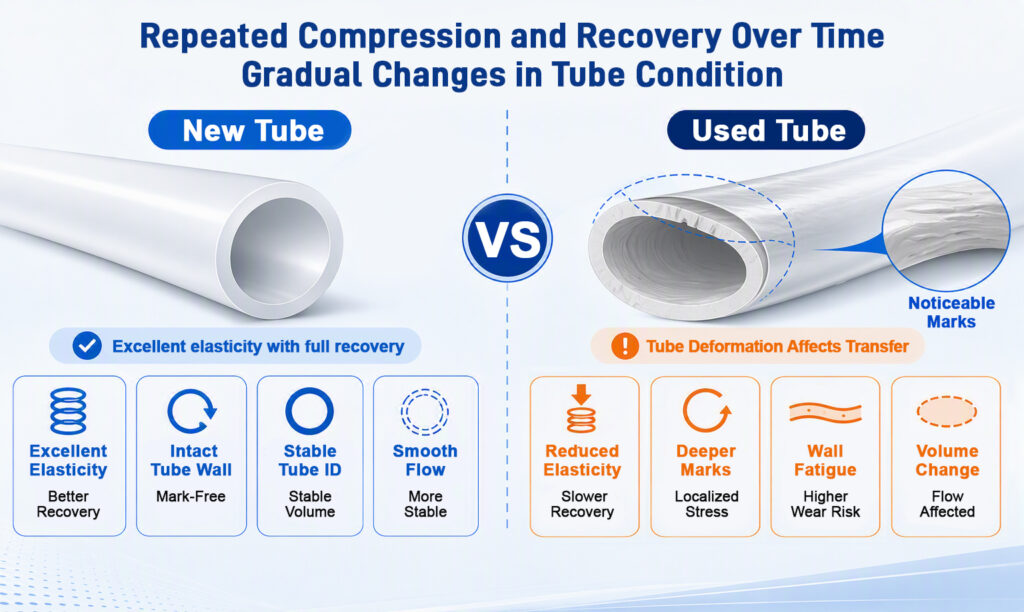
Many of these changes are difficult to detect visually, yet they are sufficient to affect pumping performance. In other words, tube does not have to be broken before it should be replaced.
Think of it like a rubber band. At first it returns to its original shape after stretching, but after repeated use, it gradually loses its elasticity.
03 What Determines Tube Service Life?
There is no universal answer. tube lifetime depends heavily on the actual operating conditions.
The following factors all influence tube wear:
Operating Time and Pump Speed
The faster the pump runs and the longer it operates, the more compression cycles the tube experiences.
System Operating Conditions
Long tube runs, high back pressure, valves, filters, and other system components can all increase the pumping load.
Fluid Characteristics
Fluid viscosity, chemical compatibility, and temperature all affect tube durability.
Compression Method
This is perhaps the most overlooked—but also one of the most critical—factors.
In most conventional rotary peristaltic pumps, the tube is repeatedly compressed until fully occluded and then released. This continuous full occlusion subjects the tube to significant mechanical stress throughout its service life.
04 The Cost of Tube Replacement Goes Beyond the Tube Itself
Replacing tube may seem straightforward.
In reality, however, it is rarely as simple as removing the old tube and installing a new one.
Particularly in automated equipment, continuous production lines, and precision dispensing systems, tube replacement often involves:
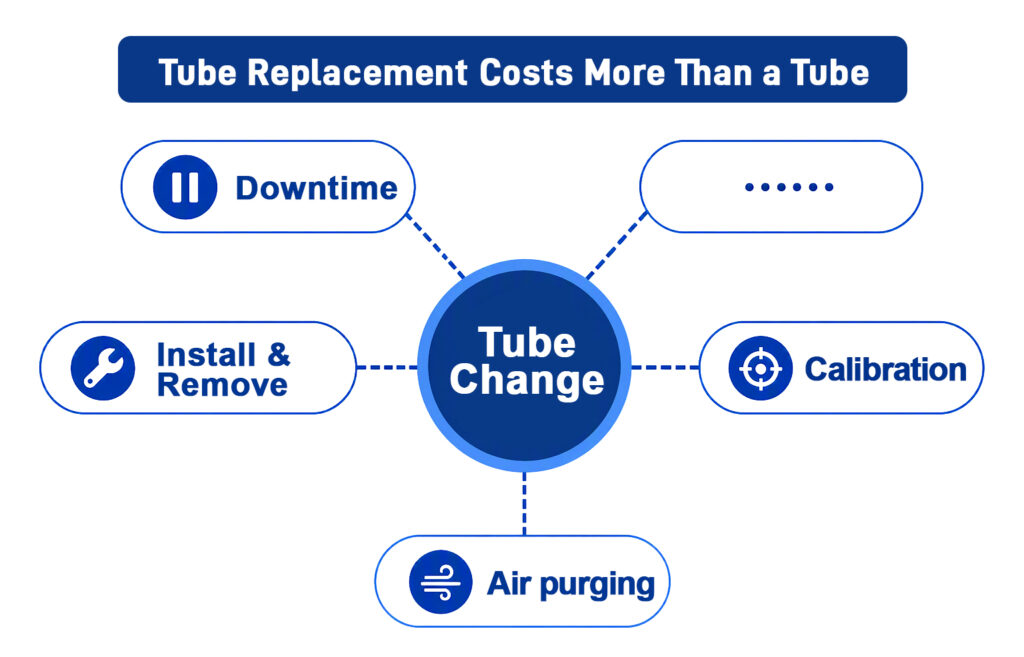
When tube replacement becomes frequent, these procedures are repeated again and again.
On the surface, only a piece of tube is being consumed.
In practice, what is really being consumed is time, labor, and system stability.
Reducing tube replacement frequency is therefore not simply about saving tube—it is about improving the reliability and efficiency of the entire fluid transfer system.
05 So, Can Tube Be Replaced Less Often?
The answer is yes, and there are two main approaches.
Approach 1: Select the Right Tube
Choose tube that matches the application, taking into account the fluid properties, flow rate, operating duration, pump head, and environmental conditions.
Approach 2: Reduce Unnecessary Over-Compression
While maintaining reliable fluid transfer, reducing the mechanical stress applied to the tube can significantly extend its service life.
Traditional pump designs rely on complete tube occlusion to ensure reliable pumping, but this also introduces continuous mechanical fatigue.
This raises a new question:
Can reliable fluid transfer be achieved without subjecting the tube to excessive compression?
Lead Fluid’s squeeze pump technology was developed around this idea.
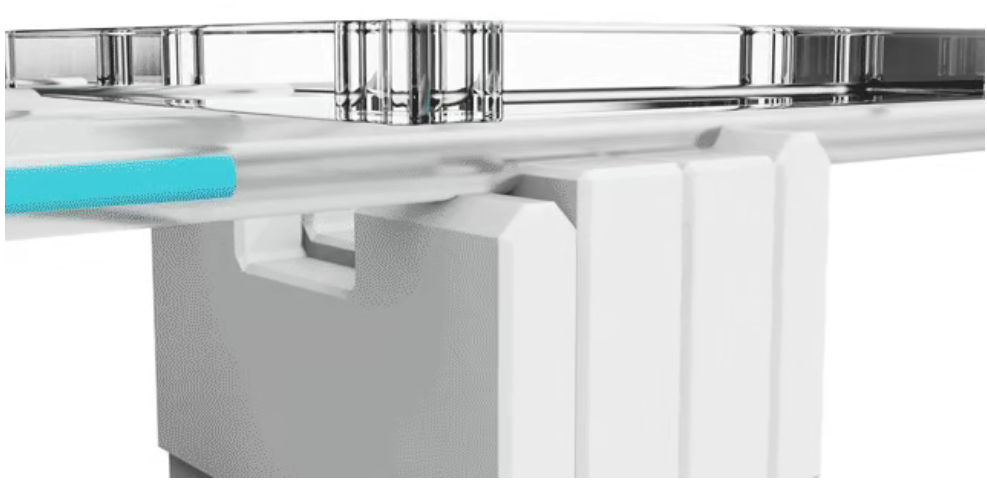
(Squeeze Pump Operating Principle)
Using an innovative dual-valve structure combined with a central compression block, the pump delivers fluid without completely occluding the tube.
This approach offers several advantages:
Reduces mechanical stress caused by repeated heavy compression
Minimizes downtime and labor associated with frequent tube replacement
Reduces the need for recalibration after tube replacement
Prevents abnormal tube wear and the risks associated with it
For applications requiring long-term, continuous, and stable fluid transfer, this design provides a more reliable and maintenance-friendly solution.
Of course, the optimal solution still depends on the specific application. Flow rate, pressure, fluid characteristics, and system configuration all influence overall performance.
From a long-term perspective, however, reducing unnecessary compression is ultimately about extending the stable operating life of the entire fluid transfer system.
Q: Why Does a Peristaltic Pump Always Require Tube Replacement?
A: Because the tube is not only the fluid pathway—it is also the working component that repeatedly undergoes mechanical stress.
While this design enables contamination-free fluid transfer, it also means the tube naturally experiences fatigue, wear, and performance changes over time.
Lead Fluid’s squeeze pump addresses this fundamental challenge by delivering fluid without complete tube occlusion, reducing tube stress and providing more stable, worry-free fluid transfer.
The Solution
Understanding real-world applications and continuously improving technology—that is the philosophy behind Lead Fluid.As a specialist in fluid transfer solutions, Lead Fluid remains committed to developing innovative products that solve real challenges faced by equipment manufacturers and end users.