
Anyone who has ever been poked by glass fibers knows how uncomfortable it can be:
Invisible, almost impossible to feel,
yet itchy and prickly and seemingly impossible to remove completely.

These tiny fibers that everyone tries to avoid are glass fibers. Despite their lightweight and delicate appearance, glass fibers offer high strength, heat resistance, and electrical insulation, making them widely used in electronics and power, transportation, aerospace, and many other industries. They provide essential material support for modern industrial development.
Antistatic Liquid Coating in Glass Fiber Production
However, these fibers—finer than a strand of hair—are not easy to handle during production.
The raw material is melted at high temperature and drawn into extremely fine fibers, which then undergo surface treatment, winding, and other processes before becoming glass fiber products for industrial application
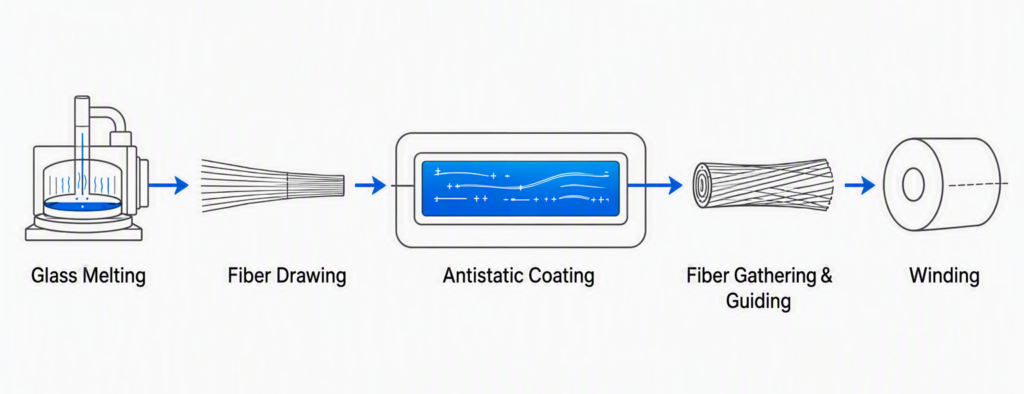
(Glass Fiber Production Process)
Throughout this process, the fibers remain in continuous high-speed motion. Friction between fibers and between the fibers and equipment can easily generate and accumulate static electricity.
Static electricity can attract contaminants and may also affect fiber gathering and the stability of subsequent processing. Therefore, antistatic liquid is typically applied evenly to the fiber surface during production.
Peristaltic Pumps Remain a Common Solution
Peristaltic pumps are widely used for antistatic liquid transfer in glass fiber production because the fluid only contacts the inner surface of the tubing, while the pumps offer a simple structure, easy maintenance, and broad application compatibility.
At glass fiber production sites, the antistatic liquid supply system needs to operate continuously alongside the production line. When the tubing reaches its maintenance interval, the equipment typically needs to be stopped for inspection, tubing replacement, and system status verification.
This is a normal part of peristaltic pump maintenance. However, for glass fiber equipment designed for long operating cycles, the impact of tubing replacement goes beyond the consumption of a single tube. Downtime and maintenance also create hidden operational costs.
As a result, an increasing number of equipment manufacturers and end users are shifting their focus beyond basic flow-rate specifications toward the long-term operating stability of the fluid supply system.
How can tubing replacement be reduced? How can maintenance frequency be lowered?
These questions are becoming increasingly important.
Lead Fluid Solution
To address the practical requirements of antistatic liquid coating in glass fiber production, Lead Fluid has introduced squeeze pump technology into the fluid supply system.
Conventional peristaltic pumps transport liquid by repeatedly occluding the tubing with rollers, subjecting the tubing to continuous cyclic compression.
Lead Fluid squeeze pumps, by contrast, use an incompletely occluding compression mechanism. This reduces the mechanical stress imposed on the tubing while maintaining stable fluid transfer and accurate metering.
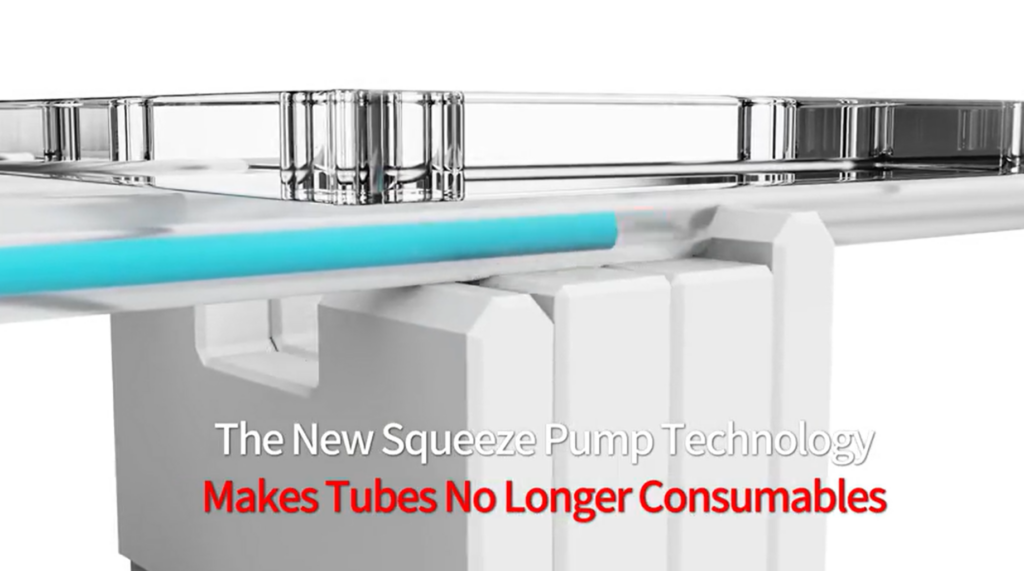
(Lead Fluid Squeeze Pump Operating Principle)
For antistatic liquid coating in glass fiber production, this means:
* Stable and continuous antistatic liquid delivery
* Reduced tubing fatigue
* Extended tubing service life
* Fewer tubing replacements and maintenance interventions
* Improved equipment continuous-operation capability
Longer Operating Cycles Are Becoming a New Measure of Value
A glass fiber antistatic liquid coating solution developed around Lead Fluid squeeze pump technology has now been operating reliably at a glass fiber manufacturer for more than 24 months, with zero tubing replacements during operation.
As the industry continues to pursue longer operating cycles and higher equipment utilization, the value of a fluid supply system is no longer simply about “delivering the liquid.”
It is about maintaining stable fluid delivery while minimizing maintenance intervention—providing stronger support for long-term, continuous equipment operation.