

September is just around the corner, and laboratories are about to get busy again.
To outsiders, a laboratory is all about lab coats, bottles and instruments, and experimental data precise to several decimal places. But spend enough time in one, and you’ll discover another unwritten “hidden system” quietly operating behind the scenes:
If the experiment isn’t working, don’t panic.
Try the lab’s time-honored “rituals” first.
Friendly reminder: Don’t rush to explain everything logically. Sometimes the truth is even funnier than the “ritual.”
Laboratory “Superstition” Files
01 | You Have to “Perform a Ritual” After Powering On
🤔 There was an experiment that apparently required a “ritual” immediately after startup. Skip it and the experiment would fail. Even worse, performing it for too short a time could also lead to failure. Over time, this became a “secret family tradition” in the lab. Newcomers never dared to ask—they simply followed along.
😮 Eventually, troubleshooting revealed the real reason: the instrument’s heating plate was aging and could no longer reach the required temperature quickly enough. Those few minutes of “performing the ritual” just happened to give the equipment enough time to warm up.
It looked like a ritual.
In reality, they were just waiting for the temperature to stabilize.
02 | The Supervisor Comes with a “Lab Success Buff”
🤔 When the supervisor was there, the experiment went smoothly. When the supervisor was away, everything went wrong. Did the experiment really “know who was in charge”?
😮 After some serious investigation, the pattern finally became clear. The supervisor suffered from rheumatism and rarely came to the lab on rainy, humid days. Coincidentally, the experiment was highly sensitive to humidity. Once humidity moved outside the suitable range, the experimental results were easily affected.
The experiment wasn’t waiting for the supervisor.
It was waiting for the right humidity.
03 | Somehow, the Experiment Was “Linked to One Person”
🤔 For the same experiment, only one person could consistently get it right. Others followed the same protocol. The reagents, instruments, parameters, and procedures were almost identical. Yet somehow, whoever else tried it failed.
😮 After repeated reviews, the real culprit was finally identified. This particular researcher had a habit of giving the pipette a tiny shake when preparing solutions, resulting in a slight difference in the actual amount added. Everyone else replicated the entire procedure except that perfectly timed little “shake.”
The experiment wasn’t recognizing a particular person.
There was simply an undocumented variable hidden in the procedure.
The End of “Superstition” Is a Hidden Variable
One “ritual” was actually waiting for the equipment to heat up.
One relied on the supervisor as a human humidity sensor.
One turned a tiny “hand shake” into a unique technique.
What we call “superstition” is often just a variable that hasn’t been discovered yet
Interestingly, peristaltic pump operation also has a few “mysterious moments” that can leave people scratching their heads.
Peristaltic Pump “Superstition” Moments
01 | The Screen Says It’s Running, So Why Isn’t the Pump Head Moving?
🤔 You press the start button. The screen shows “Running.” But the pump head barely seems to move. Is the pump slacking off?
😮 After restarting it several times and adjusting the parameters, the culprit turns out to be a surprisingly simple one something everyone can overlook: The unit was changed from mL to μL while adjusting the parameters. With the smaller unit, the calculated rotational speed becomes extremely low. The pump head isn’t actually stopped. It’s just turning so slowly that you can barely see it move.
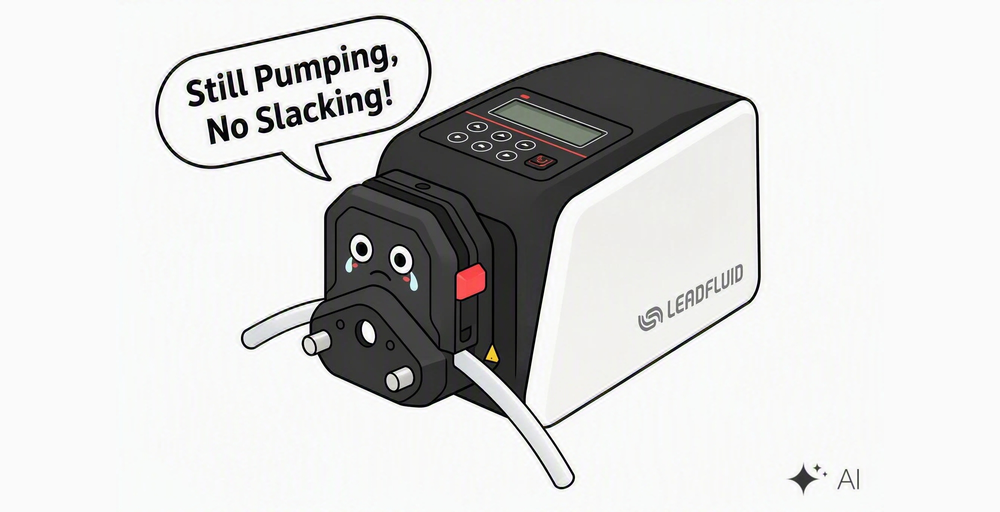
The equipment isn’t broken.
The pump isn’t slacking off.
You just changed the unit by accident.
Lead Fluid Tip:
When adjusting parameters, don’t focus only on the numbers—always check the units as well. If the screen shows that the pump is running but the pump head shows little or no visible movement, first check the unit, flow rate, and rotational speed settings.
02 | The Tube Is Installed Properly, So Why Isn’t It Working?
🤔 The tube is installed securely in the pump head. Not a single installation step was skipped. Yet after startup, there is no fluid delivery, the flow is intermittent, and sometimes there’s even leakage. Could the tube and pump head simply be a bad match?
😮 The answer lies in one word: Compatibility. Just because tube can physically fit into a pump head doesn’t mean it is suitable for use. Tube that looks like the right size—or can be squeezed into place—does not necessarily match the pump head specifications, nor does it mean the tube material is compatible with the fluid being transferred. Incorrect specifications or incompatible materials can cause problems such as failure to prime, tube displacement, wear, and leakage, even when installation is performed correctly.
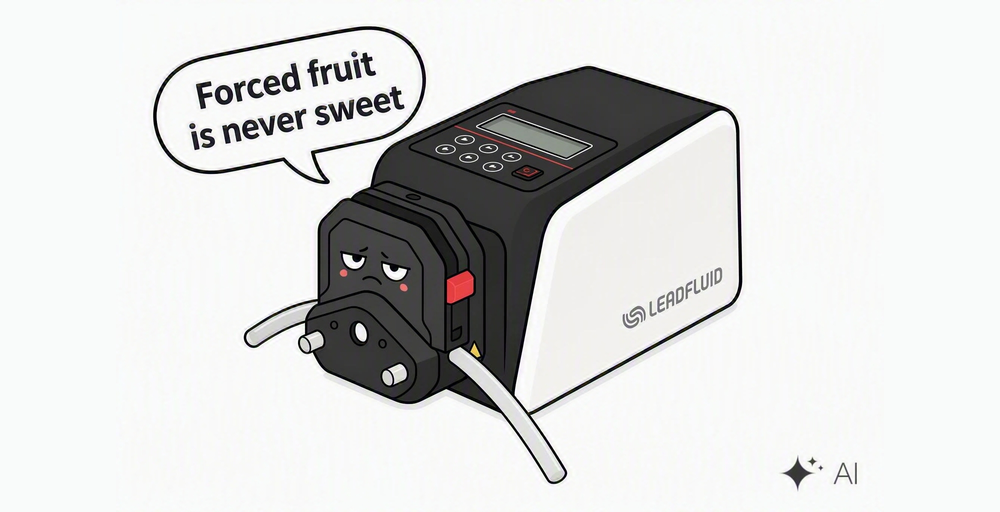
The so-called “bad match” is really an improper compatibility choice.
Lead Fluid Tip:
Don’t select tube based on appearance or intuition. Match the pump head specifications with the fluid characteristics. If you’re unsure, provide Lead Fluid with the pump model, pump head model, fluid, and required flow rate, and we can assist with tube selection.
03 | It Worked Perfectly Last Week. Why Is It “Inaccurate” This Week?
🤔 Last week, the system performed perfectly with these parameters. This week, you start it up again. Nothing has changed. Yet the flow rate has shifted. Did the system forget its “working feel” over the weekend?
😮 The equipment didn’t suffer from memory loss. The tube experienced fatigue. During operation, the tube is repeatedly compressed by the rollers. As operating time and the number of compression cycles increase, the tube’s elasticity and recovery characteristics may gradually change. As a result, the actual flow rate corresponding to the same parameter settings may also shift.
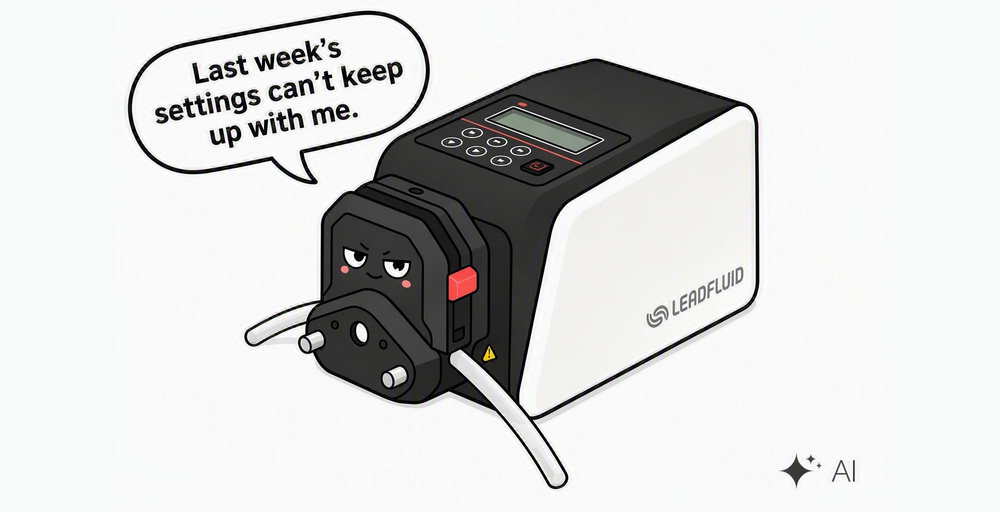
The parameters are still where they were last week.
But the tube has already moved on.
Lead Fluid Tip:
For experiments requiring high accuracy and repeatability, it is not recommended to use the same parameter settings indefinitely without verification.
After a certain period of operation, following tube replacement, or whenever flow deviation is observed, recalibration should be performed as needed.
The End of “Superstition” Is Science
Now it all makes sense, right?
Those mysterious “superstitions” in the laboratory
Once you look beyond the surface, they are often simply overlooked details and hidden variables.
A new semester means new experiments.
Keep an eye on tube condition, double-check parameter details, and choose the right compatible consumables.
Say goodbye to unexpected failures.
Make every fluid transfer stable and controllable.
Instead of relying on superstition to make your experiments work, rely on standardized procedures to keep your data reliable.
What other ridiculous-but-true “superstitions” have you encountered in your laboratory?
Share them in the comments!
Finally, wishing every researcher a great new semester:
No data drift
No equipment slacking off
Papers successfully published
Experiments successful every time!
Friendly Reminder
The laboratory “superstitions” mentioned in this article are purely for fun and scientific humor.
For actual laboratory work, always follow rigorous procedures, document operating conditions properly, and conduct experiments in a scientifically compliant manner.
Have fun with the superstitions. Win with science.