Tangential Flow Filtration (TFF)
Biopharmaceutical manufacturing involves a series of interconnected processes, from cell culture and harvest clarification to downstream purification and final filling. Among these, concentration, desalting, and buffer exchange are typical unit operations that play a critical role in subsequent processing steps and final product quality.
Tangential Flow Filtration (TFF) has become one of the most widely adopted technologies in the biopharmaceutical industry due to its excellent membrane separation capabilities.
The stable operation of a TFF system depends not only on membrane selection, membrane area, and process parameters, but also on another key factor: fluid transfer.
Why Does the Biopharmaceutical Industry Choose TFF?
When filtration is mentioned, many people immediately think of impurity removal. However, in biopharmaceutical applications, the value of TFF extends far beyond that.
Unlike conventional filtration methods, the feed solution in a TFF system does not flow directly toward the membrane surface. Instead, it continuously flows parallel to the membrane surface. Under a controlled pressure differential, components smaller than the membrane pore size pass through the membrane, while larger components, including the target product, are retained and either recirculated or collected according to process requirements.
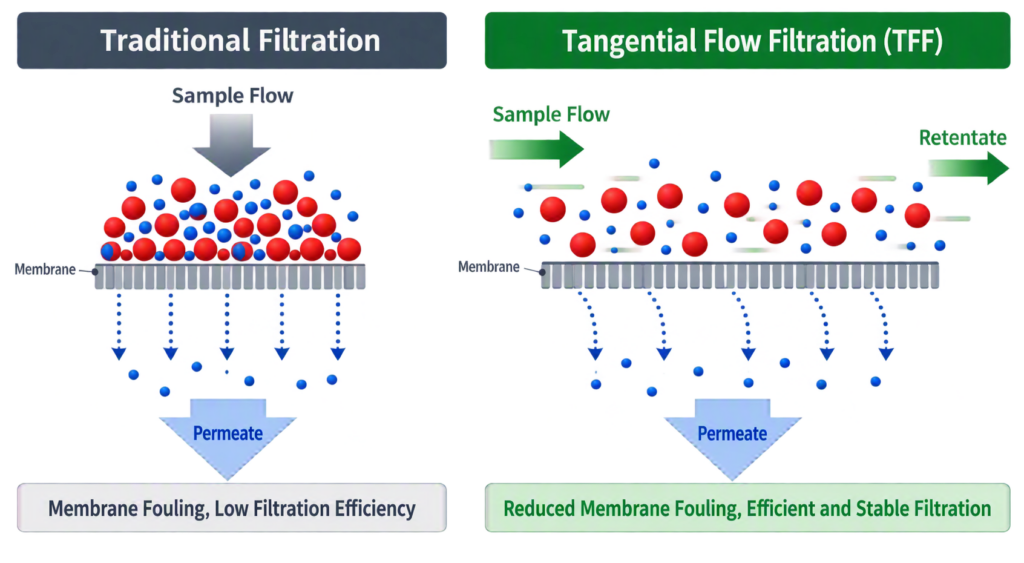
(Comparison of TFF and Conventional Filtration)
This tangential flow helps remove retained materials from the membrane surface, reducing filter cake formation and concentration polarization while minimizing membrane fouling. As a result, the filtration process remains more stable and efficient.
As the feed solution continuously passes through the membrane module, the system can gradually achieve process objectives such as concentration, desalting, and buffer exchange. To maintain stable feed circulation, fluid transfer equipment becomes an indispensable part of the system.
BT300S in TFF Applications
In a TFF system, the membrane module performs the primary separation task, while the transfer device provides the driving force for fluid circulation.
The stability of fluid transfer directly affects crossflow velocity and overall system performance. Therefore, when implementing TFF, it is important not only to focus on membrane selection but also to choose a transfer device that matches the process conditions, considering factors such as processing volume, membrane area, fluid properties, and target flow rate.
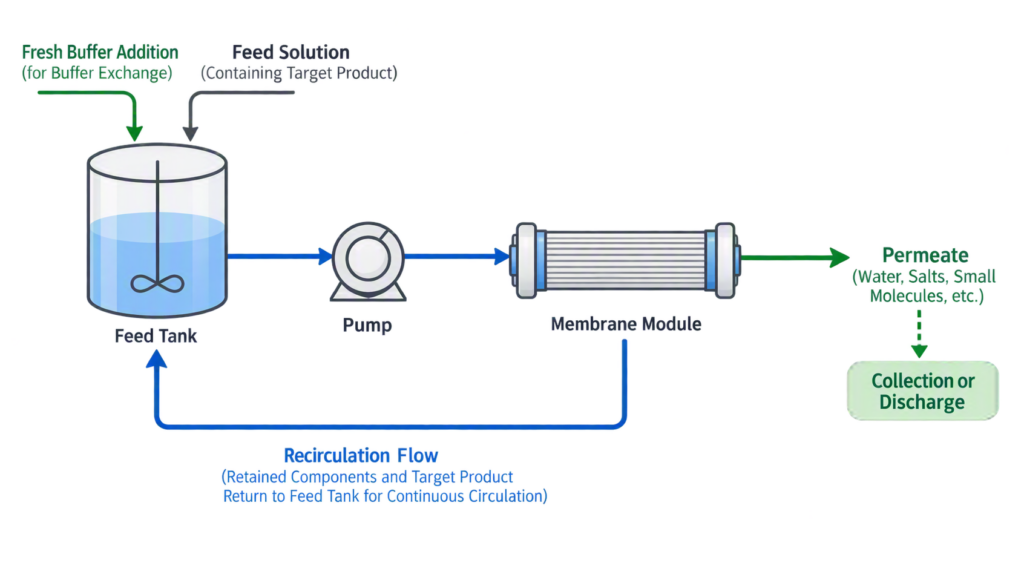
(Schematic Diagram of TFF System Operation)
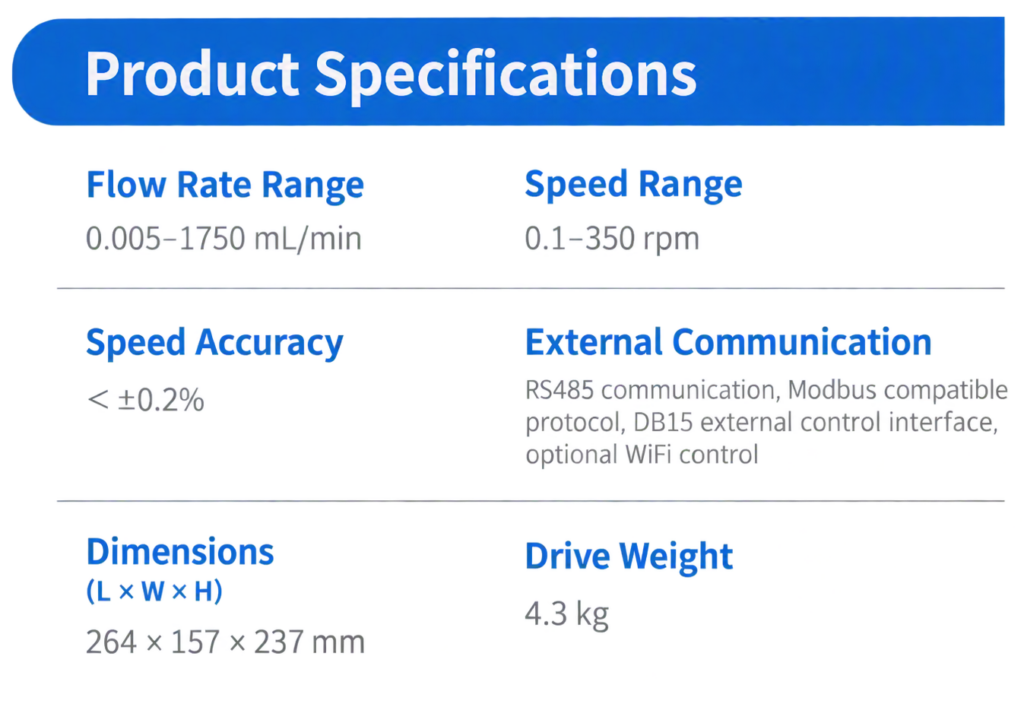
As a classic variable-speed peristaltic pump from Lead Fluid, the BT300S can be utilized in the recirculation loop of TFF systems, providing reliable power for fluid circulation.
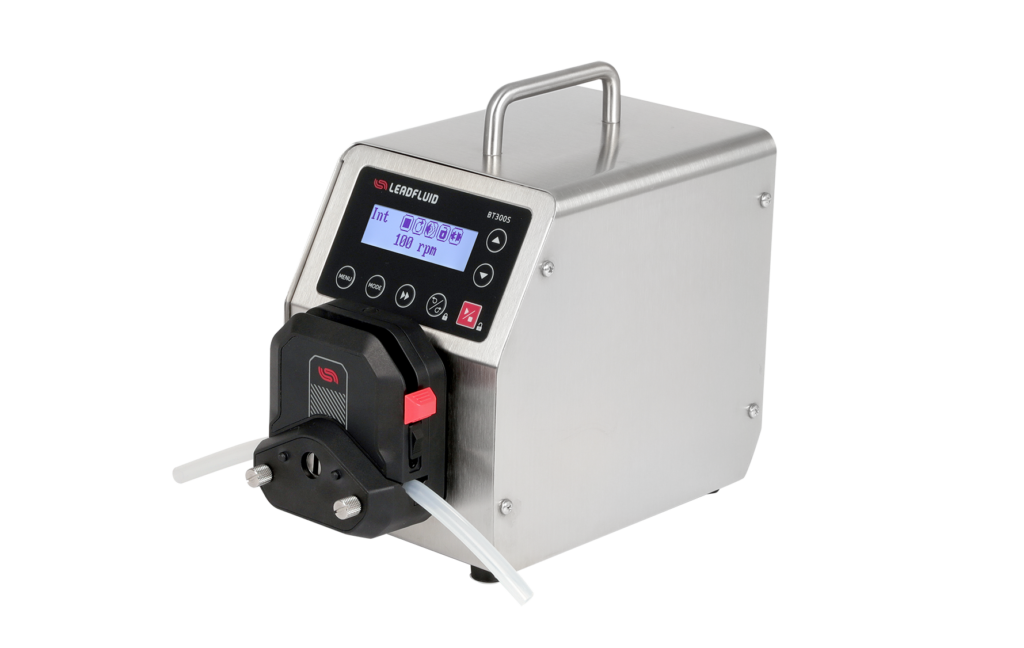
01 Precise Flow Control for Stable Transfer
The BT300S is equipped with an advanced imported processor and a high-quality stepper motor, delivering a speed control accuracy of less than ±0.2%.
In TFF applications, this precise control helps maintain a stable circulation state, supporting process parameter control and ensuring operational consistency.
02 Low Shear to Protect Biological Activity
Using a tubing-compression pumping mechanism, the fluid flows only through the tubing and does not come into direct contact with pump components. By selecting and configuring appropriate tubing, fluid path management can be simplified while helping to reduce the risk of cross-contamination.
In addition, the relatively gentle pumping action makes the BT300S particularly suitable for biological samples that are sensitive to shear forces.
03 Stable Operation for Reliable Recirculation
The BT300S features a stainless-steel housing, making it easy to clean and maintain while supporting continuous operation.
It is well suited for recirculation applications in laboratory research, process development, and TFF systems across various scales.
Stable and reliable fluid circulation provides essential support for achieving key TFF process objectives, including concentration, desalting, and buffer exchange.
About Lead Fluid
Lead Fluid remains committed to addressing fluid transfer challenges in the life sciences and biopharmaceutical industries. Through reliable products and innovative solutions, Lead Fluid supports process development and production applications worldwide, helping customers achieve efficient, stable, and scalable fluid handling performance.